
Solutions for Made Up Problems


I don't know about you, but every now and again I see something new hit the market and my immediate reaction is one raised eyebrow and a slow "...why?"
Not the "ooh that's clever" kind of why. The other one. The "who asked for this" kind of why.
It's not that I'm against progress. Far from it, I've spent most of my career getting genuinely excited about new tech. But somewhere along the way, a load of companies seem to have decided that if there isn't a problem to solve, they'll just invent one, slap some sensors and an app on it, and call it innovation.
So I thought I'd run through a few examples that have made me stop and stare at my phone/car/shopping trolley in mild disbelief recently, before getting to the bit that's actually interesting: why this keeps happening at all.
The car that opens its own door for you
First up, cars. Specifically, the 2023 BMW 7 Series, which comes with a button that will automatically open the door for you.
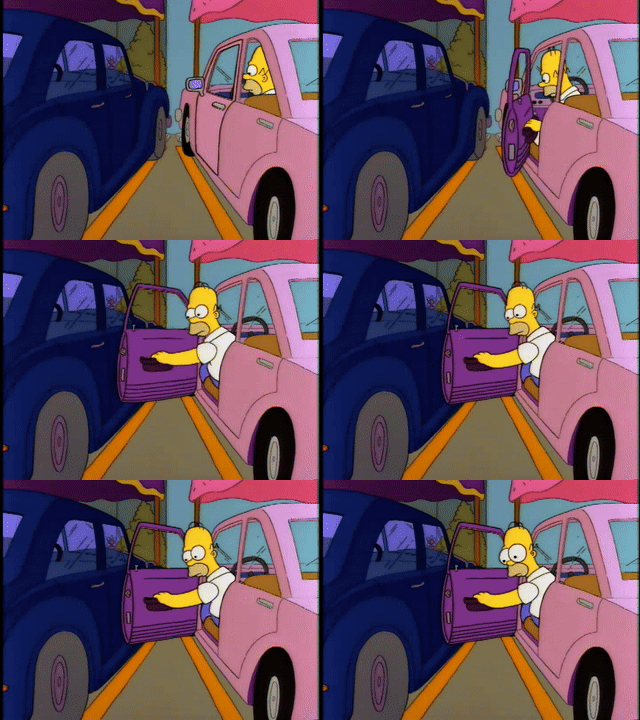
Now, I get it. Doors are heavy. Pushing them open is such a chore. But here's my favourite bit, the bit that made me actually laugh out loud when I read it. BMW themselves admit the sensors aren't foolproof:
The technology is not foolproof since there is a risk that sensors might not be able to recognize smaller objects or other car doors at certain angles. For this reason, BMW argues it's best to put your hand on the door and stop it in case it's about to slam into an adjacent object.
So let's just recap that. The solution to "opening a car door" is a button, that triggers a motor, that might not notice a bollard or the car parked next to you, so you should keep your hand on the door just in case.
Which means... you're still opening the door. You're just doing it with a slightly confused robot assisting you.
And it's not just BMW being fancy for the sake of it. The Audi Q7 will let you open and close all the doors remotely from the key, which tells me this isn't a one-off gimmick, it's becoming A Thing. Manufacturers are actively competing on who can automate the opening of a door the best.
I'm sure the engineering behind it is genuinely impressive. But the problem it solves? I'm struggling to find one 🤷
Full self driving (sort of)
Next up, the big one. Full self driving.
Now, before anyone jumps down my throat, I actually think autonomous driving is a genuinely worthwhile problem to solve. Fewer accidents, less fatigue behind the wheel, more time to do something other than sit in traffic. Fine. Great, even.
But here's my issue. Unless everyone is in on it at the same time, all the cars, all the sensors, all the pedestrians, all the cyclists, you're still going to have a road full of unpredictable humans doing unpredictable human things. Full self driving doesn't solve "bad drivers." It just adds a very confident computer into a mix that still contains all of the same lunatics it did before, whether they're behind a wheel or crossing the road without looking.
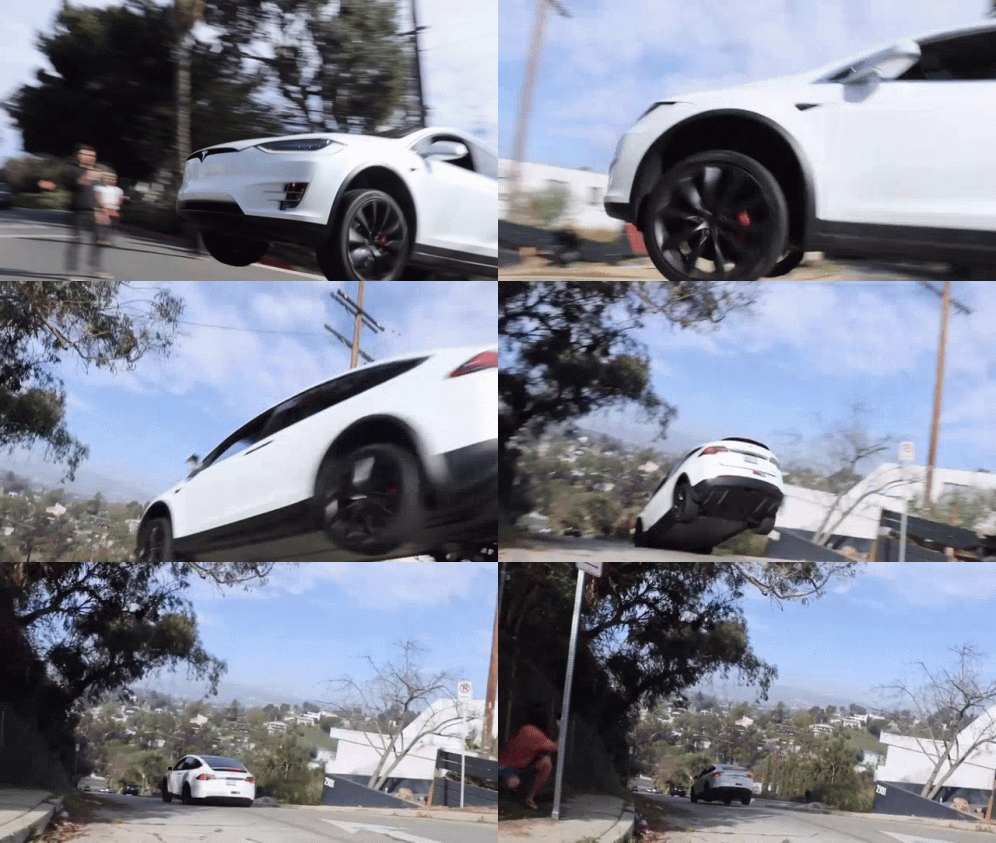
And then there's the small matter of who's actually responsible when something goes wrong. If the car is driving itself and it makes a mistake, is that the driver's fault? The manufacturer's? The software's? Genuinely, is this even a solved problem yet? Because from where I'm sitting, it feels like everyone's just quietly hoping it sorts itself out before too many court cases pile up.
Which brings me to my favourite bit of evidence that we are, in fact, nowhere near done here. This video, where someone crashes and the immediate defence is "I wasn't driving, it was the autopilot."
That, right there, is the whole problem in one sentence. We've built a solution so half-finished that its main selling point is also its best legal loophole.
AI shopping trolleys
And now for something a little closer to home. Literally, in this case, because AI-powered shopping trolleys have started rolling out in Lancashire.

I'll be honest, out of everything on this list, this is the one that made me pause the longest. A trolley. With AI in it. Helping you shop.
I don't know what problem the humble shopping trolley had that needed solving. It's a metal basket on wheels. It has done its one job, admirably, for decades. And now, apparently, it needs to be smart.
I'm sure there's a genuinely useful angle in there somewhere, maybe it nudges you towards a better route round the shop, maybe it helps people with mobility issues, and if it does, brilliant. But my gut reaction wasn't "finally," it was "...why though?"
Which is becoming a bit of a theme.
The gadget graveyard
Of course, none of this is new. We've been doing this with gadgets for years.
You know the videos I mean. Someone unboxes a product, tries to use it with a straight face, and slowly the whole thing unravels into "...why does this exist" in real time. This one's a good example.
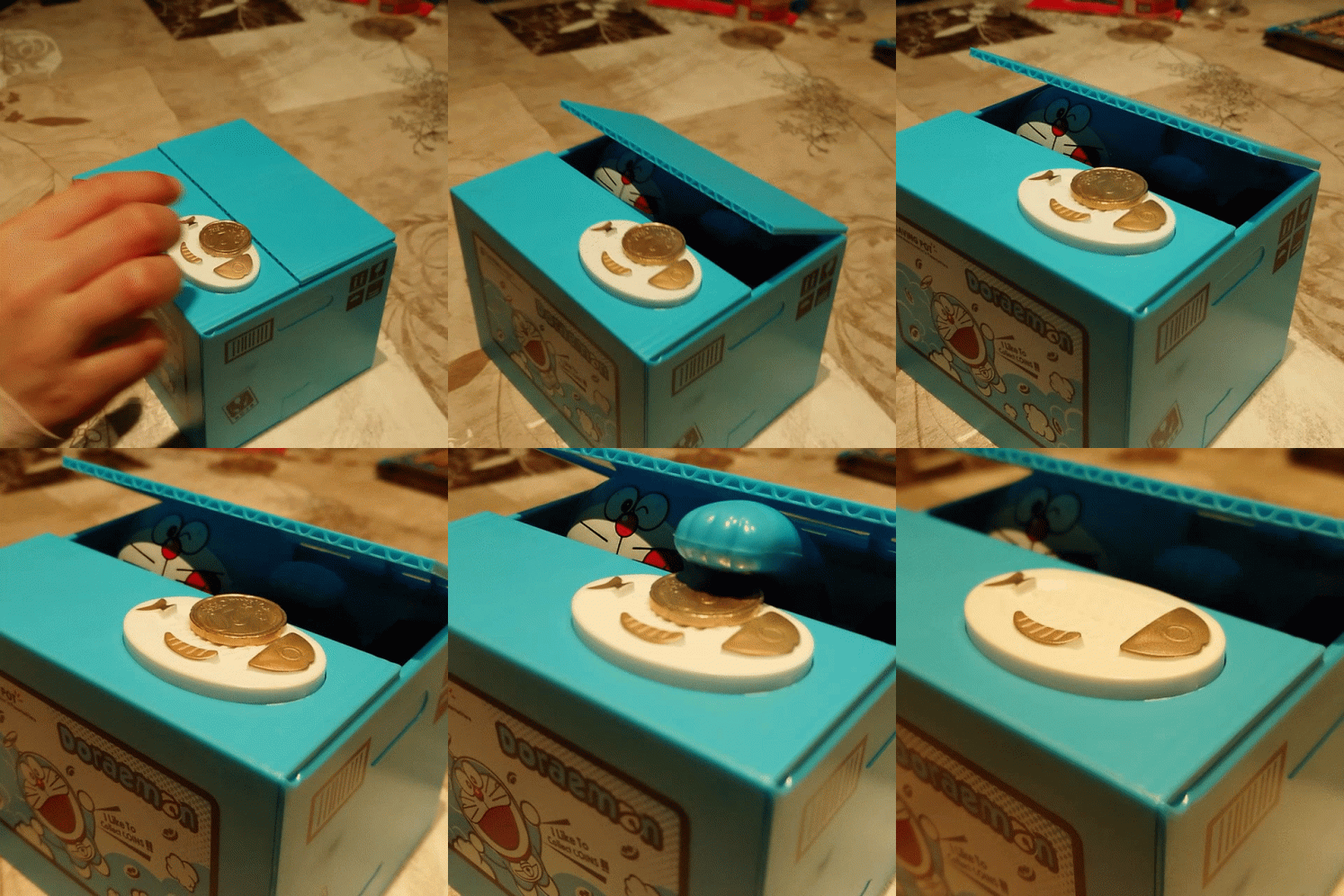
The self-stirring mug. A device whose entire purpose is to save you the immense physical burden of moving a spoon in a circle. There's also gadgets that "help with putting" (golf putting, that is), because apparently the issue was never your technique, it was that you weren't using a robot.
None of these are inherently evil. They're just... solutions, wandering around, looking for a problem to attach themselves to.
And it turns out that's not just a novelty-gadget thing anymore. It's cars. It's shopping trolleys. It's starting to feel like the norm rather than the exception.
Which got me thinking about why.
Most things that needed inventing, have been invented
Here's the conclusion I keep landing on. Most things that actually needed inventing, have been invented.
A door that opens. A car that drives. A trolley that carries your shopping. A mug that keeps your drink stirred, if you desperately want that. These are all, fundamentally, solved problems. Someone, at some point, cracked it. Job done.
And that's the real issue. Once you've solved the core problem, what's left to do? You can't just stand still, competitors will eat your lunch, so the pressure shifts from "solve the problem" to "look different from the other people who also solved the problem."
That's not the same challenge. Solving a problem is hard, but it's a fairly straightforward kind of hard, you know what you're aiming at. Differentiating from a dozen competitors who've also solved the problem is a different beast entirely, and it's the kind of pressure that leads to genuinely mad-scientist thinking. Sensors that might not spot a bollard. Trolleys with opinions. Mugs that stir themselves.
Nobody sets out to build something pointless. But when the actual problem is already solved and the real fight is "be different, or die," pointless is often exactly where you end up.
MySpace didn't see it coming
If you want proof that "solving the problem" isn't the finish line, look no further than MySpace.
Worth remembering, MySpace itself was the upgrade. Before it, if you wanted a page on the internet, you were probably a teenager hand-coding a Geocities or Freewebs site with absolutely no concept of web standards or "how to design something right." It was just a cavalcade of ideas, mashed together onto a couple of pages, glittery text, a MIDI file that autoplayed on load, animated GIFs everywhere, tables held together with hope. MySpace came along and gave people profiles, friends, a Top 8, and customisable themes without needing to touch a line of HTML. It didn't just solve social networking, it made an existing solution look ancient overnight.
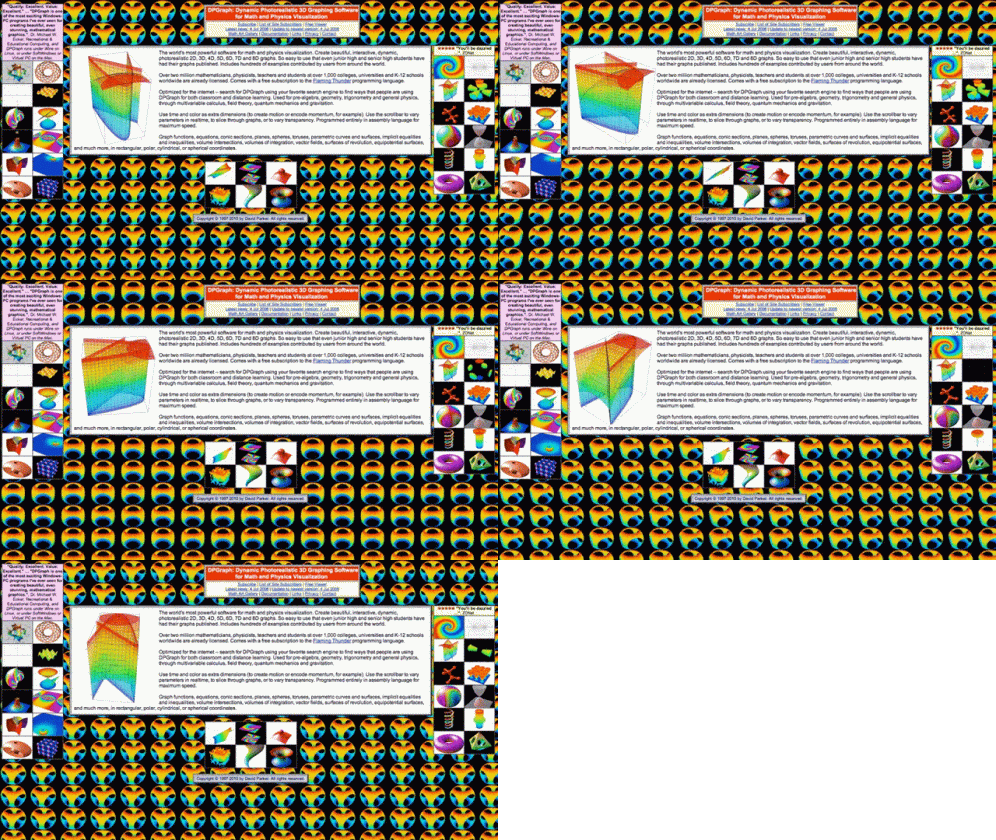
And for a good while there, it was the internet, socially speaking. I reckon a fair few people at MySpace figured that was that. Problem solved. Job done. Nothing left to invent.
Except it wasn't done, was it. Facebook turned up with a cleaner feed, a news feed that actually made sense, and a bunch of features that felt like the next step rather than a retread. And one by one, people drifted.
I was one of them. Not because I decided MySpace had gone stale, my wife did that bit for me. She convinced me to get on Facebook, and pretty much overnight my MySpace activity flatlined. Just... nothing. Gone.
MySpace didn't lose because it stopped working. The doors still opened, so to speak. It lost because everyone else kept adding features to differentiate themselves, and eventually one of them added enough alluring stuff to pull people away, one nagging spouse at a time. Which is a bit rich, considering MySpace won its own throne the exact same way.
That's the same fight the door-opening cars and the AI trolleys are in now. Nobody's trying to solve a new problem. They're trying not to become MySpace.
So, what's the actual takeaway?
I don't think any of this is a conspiracy. I don't think there's a room full of executives twirling their moustaches, dreaming up pointless features purely to harvest your data (although, let's be honest, that probably is a nice side effect for some of them).
I think it's simpler, and slightly less sinister, than that. Most of the big problems have been solved. Doors open. Cars drive. Trolleys carry shopping. Mugs hold coffee, stirred or not. And once you've solved the problem, standing still isn't an option, because someone else is quietly building the next MySpace-beating Facebook in a garage somewhere, and they don't need your permission to start pulling your users away.
So companies keep reaching. Sensors that might miss a bollard. Trolleys with opinions. Buttons for things that never needed buttons. Not because anyone asked for it, but because the alternative is standing perfectly still while everyone else invents something, anything, to look different.
Whether any of it is actually good is a different question entirely. But at least now, next time I catch myself raising an eyebrow at some new "innovation," I've got a slightly better answer to "...why?"